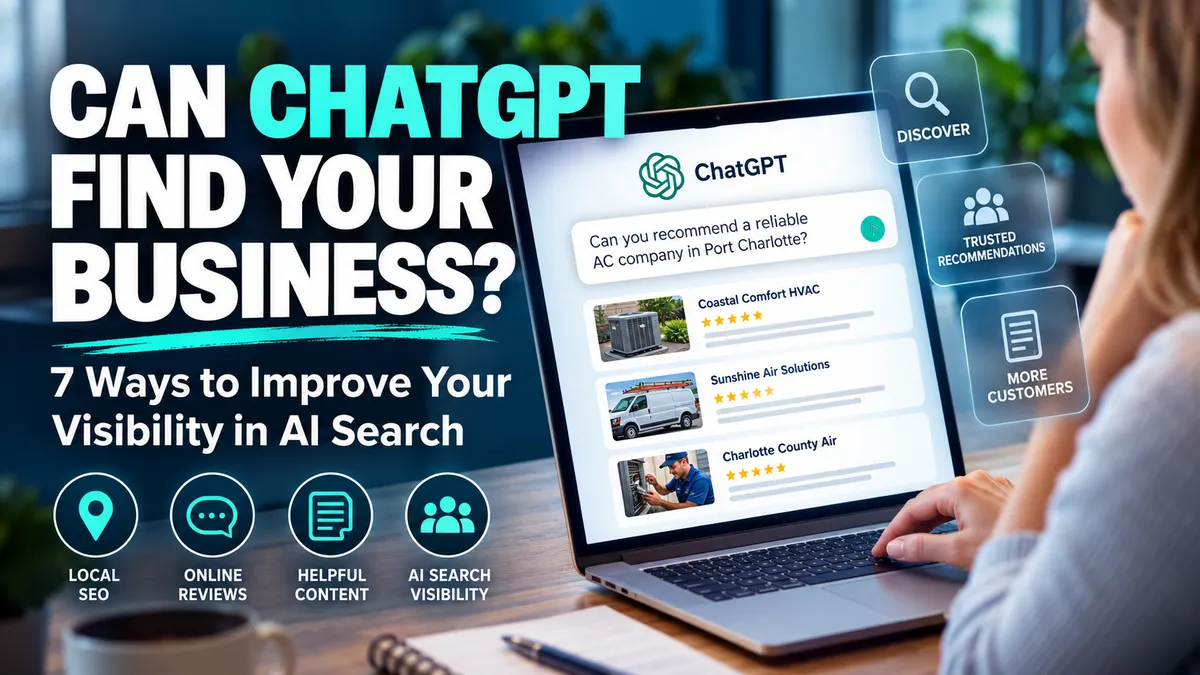
Is Your Business Invisible to ChatGPT? How to Get Recommended by AI Search in 2026
Your next customer might not be searching Google. They might be asking ChatGPT who to hire. Will your business be one of the recommendations?
For years, businesses have worked to appear on the first page of Google. They’ve invested in websites, search engine optimization (SEO), Google Business Profiles, and online reviews.
But the way customers discover businesses is changing.
Instead of typing “best air conditioning company near me” into a traditional search engine, a homeowner might ask ChatGPT:
“Can you recommend a reliable air conditioning company in Port Charlotte, Florida, with excellent reviews that offers emergency service?”
Or someone planning a home renovation might ask Gemini:
“Find three reputable remodeling contractors near North Port, Florida, and explain which one would be best for my project.”
These conversational searches introduce a new challenge for businesses.
If AI assistants can’t find enough reliable information about your business, you could be missing opportunities to be considered by potential customers.
The good news? There are practical steps you can take to improve your visibility.
Let’s explore how AI search works, why some businesses get recommended, and seven ways to help your business become easier for AI assistants to discover.
What Is AI Search Optimization?
AI search optimization is the process of making your business easier for AI-powered search platforms to discover, understand, and accurately describe.
You may also hear terms such as:
GEO (Generative Engine Optimization): Improving the likelihood that your content is discovered, referenced, or cited in AI-generated answers.
AEO (Answer Engine Optimization): Structuring information to answer questions clearly and directly.
AI Visibility: How frequently and accurately your business appears in relevant AI-generated responses.
Local AI Search: How AI assistants help people discover businesses in a specific geographic area.
While traditional SEO focuses heavily on search engine rankings, AI search optimization also considers whether your business information is accessible, understandable, credible, and relevant to conversational questions.
These approaches overlap significantly.
In fact, many practices that improve traditional SEO can also support AI discoverability.
The difference is how customers interact with the information.
Instead of browsing a list of websites, customers may receive a personalized answer that summarizes several options.
And your business may—or may not—be included.
How Does ChatGPT Decide Which Businesses to Recommend?
First, it’s important to understand something:
There is no guaranteed way to make ChatGPT recommend your business.
AI assistants don’t all work the same way, and their responses can change depending on the customer’s question, location, available information, and whether live search is used.
When AI-powered search is available, an assistant may draw from information such as:
Business websites
Publicly available business listings
Search engine results
Customer reviews and ratings
Relevant articles and publications
Industry directories
Other accessible online sources
An AI assistant may consider whether a business appears relevant to the customer’s needs, but the exact selection process varies across platforms.
For example, if someone asks:
“Who installs hurricane-impact windows in Port Charlotte?”
An AI assistant needs enough accessible information to connect a business with hurricane-impact window installation and the Port Charlotte service area.
A website that clearly describes those services and locations provides useful context.
A website with vague descriptions such as “We offer quality solutions for your home” provides much less information.
The clearer your online presence, the easier it is for search systems and AI assistants to understand what your business actually does.
7 Ways to Improve Your Business’s Visibility in ChatGPT and AI Search
1. Make Sure Your Business Information Is Consistent Everywhere
Start with the basics.
Your business name, address, phone number, website, business hours, and service areas should be accurate and consistent wherever your business appears online.
That includes your:
Google Business Profile
Bing Places listing
Website
Relevant industry directories
Social media business profiles
Other reputable local listings
Inconsistent information can create confusion for customers and automated systems.
For example, if one directory lists your business in Punta Gorda while another shows an outdated address in North Port, search platforms may have difficulty interpreting which information is current.
Action step: Audit your most important business listings and correct outdated or conflicting information.
2. Clearly Explain What Your Business Does
One of the biggest mistakes small businesses make is assuming their website visitors already understand their services.
Consider these two descriptions.
Example A:
“We provide innovative solutions and exceptional customer service.”
Example B:
“We provide residential air conditioning repair, maintenance, and installation in Port Charlotte, Punta Gorda, and North Port, Florida.”
The second description gives search engines and AI assistants much more useful information.
It identifies:
The specific services offered
The type of customer served
The geographic service area
The business’s area of expertise
This doesn’t mean stuffing keywords into every paragraph.
It means writing clear, useful content that accurately describes your business.
Action step: Review your homepage and service pages. Could someone unfamiliar with your company immediately understand what you offer, who you serve, and where you operate?
If not, start there.
3. Build a Strong Online Review Presence
Customer reviews help prospective buyers evaluate businesses.
They can also provide publicly available information about customer experiences, service quality, and the types of work a company performs.
For example, a plumbing company with detailed reviews mentioning emergency repairs, water heater installations, and prompt service provides more descriptive context than a company with very little online feedback.
However, reviews do not guarantee AI recommendations, and different platforms may use review information differently.
The goal should be to build a genuine, consistent reputation.
Encourage satisfied customers to share honest feedback.
Respond professionally to reviews.
And make leaving a review as easy as possible.
Action step: Implement an automated review request process that follows up with customers after completed services.
At Autocraft Studios, we help businesses automate review requests and manage customer feedback without adding more administrative work.
4. Create Content That Answers Real Customer Questions
Think about how people actually talk to AI assistants.
They rarely use perfect marketing keywords.
Instead, they ask conversational questions such as:
“How much should it cost to replace an air conditioner in Florida?”
“What’s the difference between pressure washing and soft washing?”
“How do I know whether my roof needs to be replaced?”
“What should I look for when hiring a local electrician?”
These questions create excellent opportunities for useful website content.
Rather than writing generic blog posts, answer the questions your customers ask before making a purchasing decision.
Include practical explanations, relevant examples, and clear answers.
For example, an HVAC company might publish:
“How Much Does AC Replacement Cost in Southwest Florida in 2026?”
That article could explain pricing factors, equipment options, installation considerations, and common homeowner questions.
Useful content can improve traditional search visibility while also making your website a more informative resource for AI-powered discovery.
Action step: Write down the ten questions your customers ask most frequently. Turn those questions into helpful articles or FAQ sections.
5. Optimize Your Website for Search Engines and AI Crawlers
Even excellent content may be difficult to discover if your website has technical problems.
Important considerations include:
Mobile-friendly design: Your website should work well on smartphones and tablets.
Fast loading speeds: Slow websites create a poor user experience and can interfere with efficient crawling.
Clear page structure: Use descriptive headings, organized content, and meaningful page titles.
Indexability: Make sure important pages aren’t accidentally blocked from search engine indexing.
Structured data: Where appropriate, add schema markup that accurately identifies your business, services, and other relevant information.
Crawler access: Review whether your website allows the search crawlers used by the platforms you want to reach.
These improvements support a strong technical foundation.
Keep in mind that allowing a crawler access doesn’t guarantee that your content will appear in AI-generated answers.
Action step: Have your website evaluated for technical SEO issues, indexing problems, and opportunities to improve how your business information is presented.
6. Strengthen Your Business’s Online Authority
AI search visibility isn’t just about what you say about your own company.
Independent, credible sources can also help establish your business’s presence online.
Examples include:
Local Chamber of Commerce directories
Reputable industry associations
Local news coverage
Relevant professional directories
Community organization websites
Partnerships with other established businesses
For example, a contractor featured in a local publication or listed by a relevant professional association may have additional publicly available information supporting its business identity and expertise.
These mentions can help customers discover and evaluate your business.
Their effect on AI recommendations, however, is not guaranteed.
Action step: Look for legitimate opportunities to increase your business’s presence on relevant, trustworthy websites.
Avoid paying for low-quality directory placements or creating artificial mentions simply to manipulate search results.
7. Test Whether AI Assistants Can Find Your Business
Here’s something every business owner can try today.
Open ChatGPT, Gemini, or another AI assistant with search capabilities enabled.
Ask questions a potential customer might use.
For example:
“Recommend three highly rated pressure washing companies in Port Charlotte, Florida.”
Or:
“Who provides AI business automation services in Southwest Florida?”
Then try:
“What can you tell me about [Your Business Name]?”
Pay attention to:
Whether your business appears in relevant recommendations
Whether the assistant accurately describes your services
Whether your location and contact information are correct
Which competitors appear
What sources are cited, if any
Try multiple questions and repeat the exercise periodically.
AI-generated answers can vary between sessions and users, so one test isn’t a definitive measurement of your visibility.
But these checks can reveal useful opportunities.
Action step: Create a short list of customer questions and periodically evaluate how your business appears across different AI platforms.
SEO vs. GEO vs. AEO: Do You Need All Three?
You may be wondering whether traditional SEO is becoming obsolete.
The short answer is no.
Traditional SEO remains an important foundation for online visibility.
GEO and AEO build on many of the same principles.
Here’s a simple comparison:
SEO (Search Engine Optimization): Helping websites appear in traditional search results.
GEO (Generative Engine Optimization): Improving discoverability and representation in generative AI answers.
AEO (Answer Engine Optimization): Making content easy to understand and use when answering questions.
These strategies work best together.
A well-optimized business website should provide clear information, answer customer questions, establish credibility, and make it easy for visitors to take action.
The goal isn’t to abandon Google.
It’s to make your business discoverable wherever your customers are searching.
Why AI Search Visibility Matters for Local Businesses
Clear, consistent online information helps local customers find your business and make informed decisions when they are ready to hire.
How Autocraft Studios Helps Businesses Improve Their Online Visibility
At Autocraft Studios, we believe technology should make running a business easier—not more complicated.
We help small businesses build stronger digital foundations while automating the everyday processes that consume valuable time.
Our solutions include:
Online Visibility Optimization
Helping businesses improve the accuracy, consistency, and accessibility of their online information.
Reputation Management
Automating customer review requests and helping businesses maintain a stronger online reputation.
Website Optimization
Creating more effective websites that clearly communicate services and help turn visitors into leads.
AI-Powered Customer Communication
Using AI voice agents, automated messaging, and unified communication tools to help businesses respond to customer inquiries.
Lead Follow-Up Automation
Helping businesses stay connected with potential customers through automated follow-ups, appointment reminders, and customer communication.
Because getting discovered is only part of the equation.
You also need a system that helps turn that interest into paying customers.
Is Your Business Ready for the Next Generation of Search?
Your potential customers are discovering new ways to find businesses.
Some will continue searching Google.
Others will use ChatGPT, Gemini, and emerging AI-powered search tools.
The businesses that adapt will be better positioned to make their services discoverable across these different channels.
You don’t need to become an AI expert.
You need accurate business information, useful content, a strong online reputation, and technology that supports your customers.
And you don’t have to figure it all out yourself.
Find Out How Visible Your Business Really Is
Could potential customers be overlooking your business when they search with AI?
Autocraft Studios can help you evaluate your current online presence and identify opportunities to improve your visibility.
Book a free 15-minute growth call to discuss your online visibility.
Discover opportunities to strengthen your online presence, improve your reputation, and help more customers find your business.
Autocraft Studios — We stay ahead, so you don’t fall behind.
Frequently Asked Questions About ChatGPT Business Recommendations
Can I pay ChatGPT to recommend my business?
There is no standard paid placement that guarantees your business will be recommended in ChatGPT’s organic answers. Advertising products, where available, are separate from organic recommendations.
Does ChatGPT use Google Business Profiles?
ChatGPT may use web search providers and publicly available sources when search is enabled. Google Business Profile information may be accessible through public web sources, but you shouldn’t assume ChatGPT directly accesses Google’s business listing database.
Maintaining an accurate Google Business Profile remains important for local search visibility.
How do I get my business listed in ChatGPT?
There isn’t a universal registration process that guarantees your business will appear in ChatGPT recommendations.
Focus on maintaining an accessible website, accurate business listings, helpful content, and a credible online presence.
Do Google reviews help with AI search visibility?
Reviews can provide useful information about a business’s reputation and customer experiences. Their influence varies by AI platform and search context.
Authentic reviews remain valuable for helping customers evaluate your business.
What is the difference between SEO and GEO?
SEO focuses on improving visibility in traditional search engine results.
GEO focuses on making content more discoverable and useful within generative AI search experiences.
Both benefit from accurate information, helpful content, and strong technical website foundations.
Can small businesses compete with larger companies in AI search?
Yes. Small businesses can make themselves highly relevant to specific services and geographic areas.
Clear service descriptions, locally relevant content, and accurate business information can help smaller companies compete for attention in their markets.
How long does AI search optimization take?
There is no universal timeline.
Changes to your website or business listings may take time to be discovered, indexed, and reflected in search systems.
AI-generated recommendations also vary, so progress should be evaluated across multiple relevant searches rather than a single result.