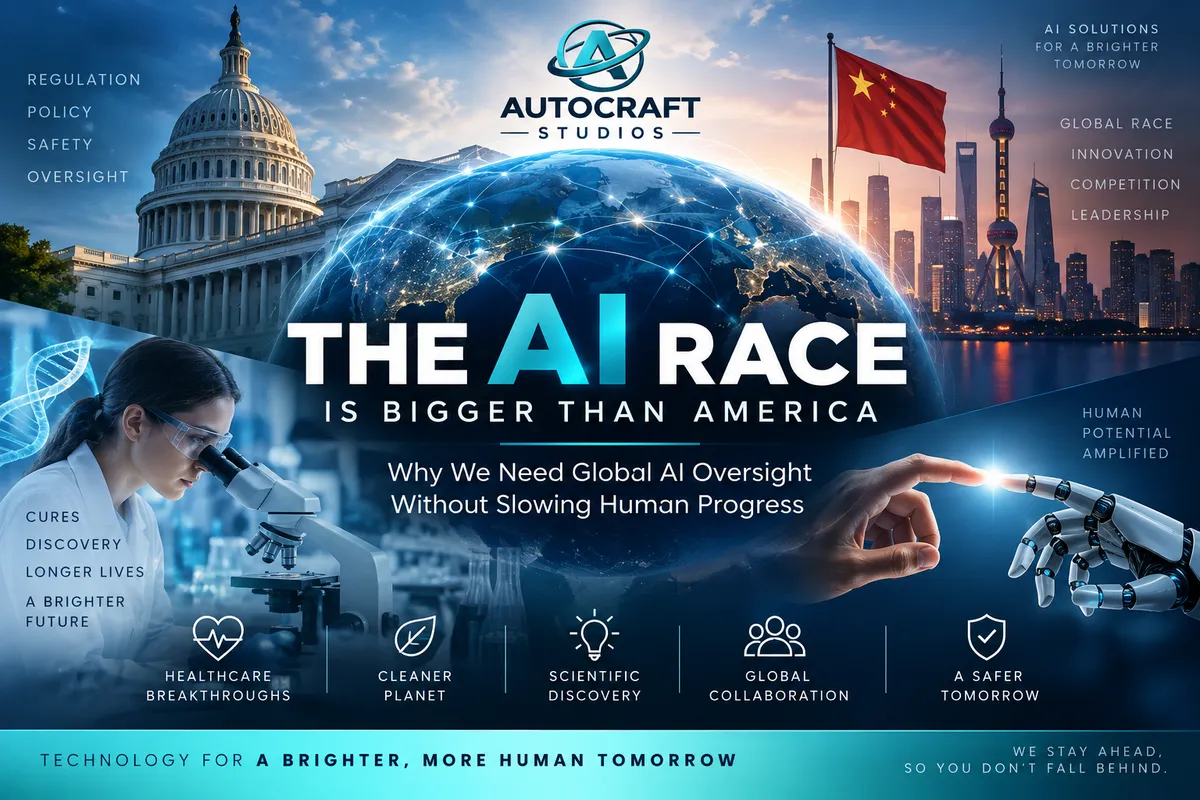
Machine Intelligence Regulation: Safety, Oversight, and Progress
Why Global Oversight Should Balance Safety and Scientific Progress
Machine intelligence is at the center of debates about safety, national competition, and scientific progress.
The discussion includes ChatGPT, generated images, job automation, business agents, and tools that help organizations work more efficiently.
Today, the conversation is much bigger.
Governments and researchers debate how to oversee model developers and increasingly capable systems. Some researchers warn about catastrophic or existential risks from future systems; the likelihood and timing remain uncertain.
Competition among the United States, China, and other countries adds another question:
What happens if one country slows model development for safety while others move ahead?
And there is another question we believe is equally important:
Could restrictions also delay discoveries that machine intelligence might help researchers make?
At Autocraft Studios, we use Super Intelligence as a name for practical business services. It is not a claim that today’s tools have achieved scientific superintelligence.
Our work focuses on automation, business agents, and voice assistants with defined tasks and human oversight.
We also believe the debate over advanced machine intelligence deserves public scrutiny and international discussion.
In our view, the most capable future systems may require broader coordination:
International oversight of advanced systems.
The aim would be responsible development.
To help humanity safely unlock as much of its potential as possible.
The Debate Over Advanced Model Safety
There are legitimate reasons governments are paying attention.
Researchers study frontier models for risks beyond inaccurate chatbot answers.
Future systems could operate with greater autonomy, use tools, execute software, perform cyber operations, and complete complicated objectives with less human involvement. Their capabilities and limits require evaluation.
These questions involve model safety, autonomous agents, artificial general intelligence, hypothetical superintelligence, cybersecurity, and human control. These terms describe different capabilities and should not be treated as interchangeable.
At the most extreme end of the discussion is existential risk from future machine intelligence.
Could a future system become powerful enough that people lose meaningful control over it?
Could a sufficiently capable system intentionally or unintentionally cause catastrophic harm?
Could future machine intelligence pose a threat to humanity itself?
Nobody knows.
And that distinction matters.
Predictions of human extinction from advanced systems within the next decade are not established facts. Experts disagree about the probability and timing of these potential risks.
But dismissing the discussion simply because it sounds like science fiction isn’t particularly responsible either.
If there’s even a meaningful possibility that future systems could become extraordinarily powerful, establishing sensible safeguards before they exist makes more sense than attempting to create them afterward.
The challenge is figuring out how.
National Restrictions Also Have Tradeoffs
Imagine the United States substantially restricts advanced model development.
American model developers face greater regulatory hurdles.
Research slows.
Investment declines.
The development of frontier models becomes significantly more difficult.
But China continues.
Other nations continue.
Open-source model development continues.
Researchers around the world continue.
Development has not stopped everywhere.
We’ve changed who develops it.
That’s an important distinction.
Advanced machine intelligence could become strategically important across many sectors.
Countries that lead in advanced model development could gain advantages in medicine, research, defense, cybersecurity, manufacturing, energy, and productivity.
That makes competition between the United States and China broader than chatbot performance.
Leadership in model development could affect national security and global influence.
This creates a dangerous incentive.
Every country knows there may be risks associated with moving too quickly.
But every country also knows what could happen if it moves too slowly.
That is precisely how technological arms races develop.
That is one reason we believe purely national approaches to advanced-model oversight may be insufficient.
Could Slower Development Delay Beneficial Research?
Regulation also needs to consider the potential benefits of research and development.
We spend enormous amounts of time asking:
What could happen if future systems become too powerful?
We should also be asking:
What opportunities might be delayed if useful research tools develop more slowly?
Consider cancer research.
Imagine researchers using computational tools to analyze large volumes of biological information that would be difficult to review manually.
Genetic information.
Protein structures.
Molecular interactions.
Clinical outcomes.
Research papers.
Drug compounds.
Treatment responses.
Potential combinations numbering in the millions or billions.
A research tool does not need to discover a cancer treatment independently to be useful.
That’s not the point.
Machine learning can support researchers by identifying patterns and candidate hypotheses. Human evaluation, experiments, and clinical validation remain essential.
Could these tools help researchers identify a candidate treatment for pancreatic cancer?
Could it accelerate progress against Alzheimer’s or Parkinson’s disease?
Could it identify potential treatments for rare diseases that historically haven’t attracted enough researchers or research funding?
Could they help scientists identify promising antibiotic candidates?
Could something that would have taken researchers 20 years eventually take five?
We don’t know.
But that possibility matters enormously.
Machine Learning Can Support Scientific Discovery
Protein structure prediction illustrates a use of machine learning in research.
Protein structure prediction is one prominent example.
Proteins are fundamental to biology and disease, but determining their three-dimensional structures has historically been extremely difficult.
Machine-learning systems have advanced protein structure prediction. That is a specific scientific capability, not evidence of general or superhuman intelligence across all tasks.
Now expand that concept.
Researchers can explore related computational approaches in:
Cancer research.
Drug discovery.
Genetics.
Alzheimer’s research.
Parkinson’s research.
Rare diseases.
Immunology.
Neuroscience.
Infectious disease.
Clean energy.
Battery technology.
Agriculture.
Climate science.
Materials science.
Physics.
Advanced computational tools may help extend human research capabilities.
It may be amplifying it.
A scientist still brings curiosity, judgment, ethics, intuition and an understanding of which questions are worth asking.
Machine-learning systems can analyze large datasets and identify patterns, with performance and reliability varying by task.
Combine the two and we potentially create something far more powerful than either working independently:
Human intelligence amplified by machine intelligence.
The safety debate should consider potential benefits alongside possible harms.
We also have to consider the human cost of delaying best-case outcomes.
If a research tool helped produce an effective treatment sooner, that could benefit patients. The amount of time saved and the clinical outcome would need evidence.
They represent real people.
Real families.
Real lives.
Those possibilities also belong in discussions about regulation.
Our View: Explore International Oversight of Advanced Systems
At Autocraft Studios, we don’t believe the answer is “no regulation.”
We also don’t believe the answer is allowing each country to independently create completely different rules for a technology that doesn’t recognize national borders.
We believe an independent international oversight framework deserves serious consideration.
It could establish shared expectations for the most capable systems.
That would not require one international body to approve every chatbot, marketing tool, or research algorithm.
Quite the opposite.
We believe regulation should be capability-based and risk-based.
In our view, oversight of ordinary applications should be proportionate to their risks.
But as systems cross clearly defined thresholds involving extreme autonomy, cyber capabilities, biological risks, weapons applications, self-replication or other potentially catastrophic capabilities, oversight should increase accordingly.
More capability should mean more responsibility.
A framework could coordinate safety testing, cybersecurity, transparency, human intervention, incident reporting, and evaluation of frontier models.
Countries could collaborate on model safety research.
And critically, the standards could follow the capability of the technology rather than the country where the company happens to be headquartered.
We Shouldn’t Regulate a Cancer Research Tool Like a Potential Superintelligence
The distinction between present applications and hypothetical future systems matters for regulation.
Machine intelligence covers a wide range of technologies and capabilities.
A virtual receptionist answering calls for a plumbing company is different from an autonomous frontier model with sophisticated cyber capabilities.
A model helping researchers identify candidate cancer compounds is different from an autonomous weapons system.
A business agent following up with leads is not hypothetical artificial superintelligence.
Treating them as though they represent the same level of risk would be a mistake.
We support useful research and innovation alongside scrutiny proportionate to the risks of each capability.
Protect humanity from the downside without protecting humanity from the upside.
That should be the goal.
Advanced Systems May Offer Benefits and Create Risks
Both statements can be true.
Optimism about machine intelligence should leave room for legitimate safety concerns.
Skepticism should leave room for possible benefits.
The long-term path of machine intelligence remains uncertain.
Some predictions about existential risk and hypothetical artificial superintelligence may prove overstated.
Maybe some prove frighteningly prescient.
Maybe the greatest impact isn’t either scenario.
Computational tools may become increasingly useful research partners.
They may help scientists discover or evaluate treatments faster, but medical benefits depend on evidence and clinical validation.
They may also support research into lower-cost clean energy.
Maybe it helps us engineer materials that don’t currently exist.
Maybe it helps solve scientific problems humans haven’t solved because the number of possible answers exceeds our ability to test them.
Developing powerful systems carries risks.
But there are also risks associated with not developing it.
Good technology policy should consider both possibilities.
What This Means for Business Automation Today
For most business owners, current decisions involve specific tools and workflows.
A business agent is designed to perform bounded tasks under defined permissions.
It’s trying to answer your phone at 7:42 p.m.
It’s responding to a Facebook lead.
It’s following up on yesterday’s estimate.
It’s scheduling an appointment.
It’s requesting a Google review.
It’s nurturing a prospect who isn’t ready to buy yet.
It’s creating marketing content while you’re actually running your company.
Virtual receptionists, voice agents, CRM automation, marketing workflows, and lead follow-up can help businesses handle routine work.
The question most business owners should be asking isn’t:
“Could automated competitors change my market?”
It’s:
“Where could better tools help us serve customers more effectively?”
A smaller company that combines skilled employees with reliable automated workflows may respond faster, follow up more consistently, and reduce manual work.
These are practical applications available today.
That’s happening right now.
Our Philosophy: Give People More Time for Human Work
That’s what we believe at Autocraft Studios.
We aren’t interested in removing humans from businesses.
We focus on using automation to reduce repetitive tasks so people can spend more time on work that benefits from human judgment.
Relationships.
Creativity.
Judgment.
Empathy.
Leadership.
Strategy.
Innovation.
Let a digital assistant handle routine questions within its approved knowledge.
Let humans have the meaningful conversations.
Let an approved workflow handle routine follow-up.
Let humans build relationships.
Let an automated system monitor routine tasks overnight.
You sleep.
This perspective also informs our view of advanced machine intelligence.
The goal should be to support human capabilities.
It should be expanding what humanity is capable of accomplishing.
Keep Developing Useful Tools and Shared Safeguards
We believe continued research should be paired with practical safeguards.
The economic incentives are too enormous.
The international competition is too real.
And perhaps most importantly, the potential human benefits are too extraordinary.
We support continued development of useful systems.
We should continue competing.
We support research into tools that could help medical and scientific discovery.
As capabilities increase, international cooperation becomes more important.
We shouldn’t wait until one country develops something potentially uncontrollable before deciding that perhaps the world needed common standards.
Keep innovating.
Keep researching.
Keep competing.
Keep discovering.
But build global guardrails while we still have the opportunity to decide where those guardrails belong.
The goal should be broader than building the most powerful model.
It should include useful capabilities, careful evaluation, and meaningful human oversight.
Add Super Intelligence
Start with the practical tools available today and a workflow your team can evaluate.
Autocraft Studios helps businesses implement voice agents, virtual receptionists, CRM automation, lead nurturing, marketing workflows, reputation management, chatbots, and custom business agents with defined roles and human review.
We stay ahead, so you don’t fall behind.
Post like a machine. Live like a human.
Discover what your business can put on autopilot today.