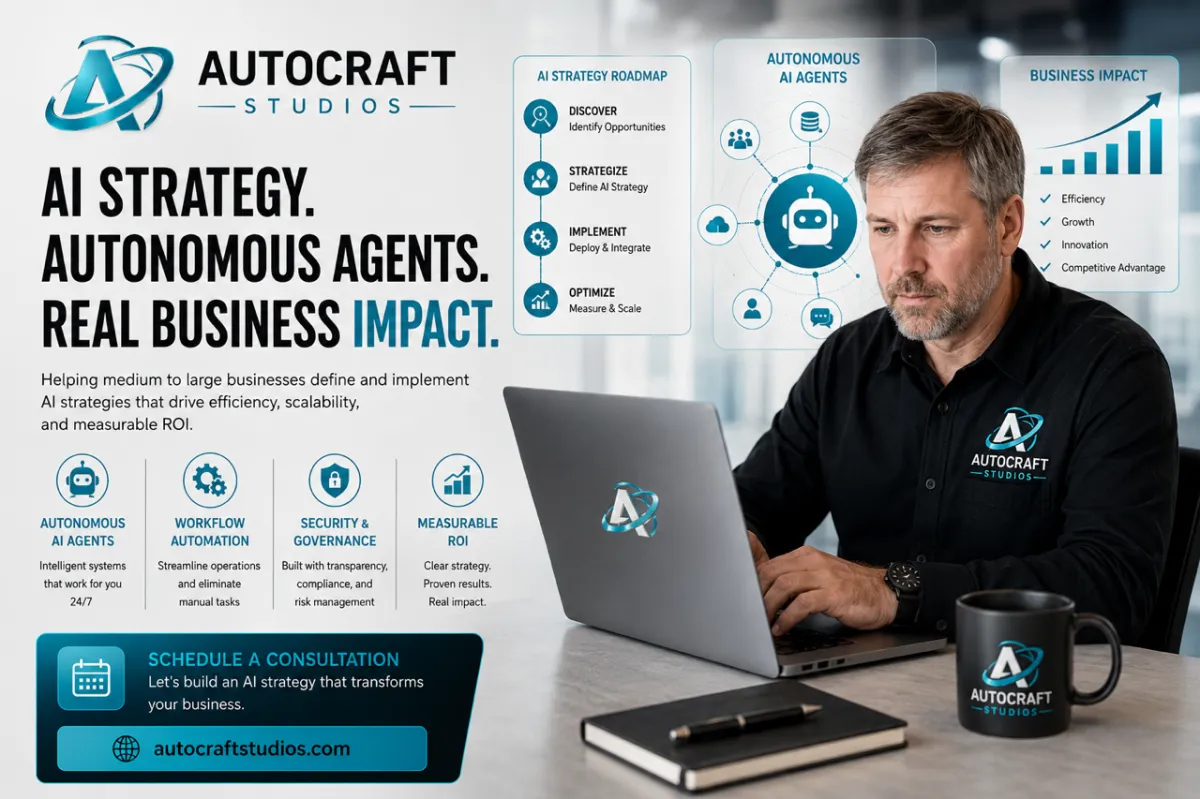
Why Businesses Need an Implementation Strategist for Business Automation
Why Businesses Need an Implementation Strategist for Business Automation
Adding Super Intelligence to a business takes planning: the tools must fit its workflows, data, security requirements, and goals.
New language models, business agents, workflow platforms, and enterprise automation systems frequently enter the market with productivity promises.
For medium and large businesses, choosing tools is only part of the challenge.
The larger task is developing an implementation strategy that is secure, scalable, measurable, and aligned with business goals.
That is whereAutocraft Studios takes a different approach.
Meet Nathan Ooley — Business Automation Strategist
Nathan Ooley is more than an automation specialist.
Nathan Ooley helps businesses evaluate, implement, govern, and improve digital assistants and agent systems across operations, customer experience, communication, and internal workflows.
Nathan specializes in:
Business agents with defined permissions
Agent workflow automation
Conversational assistants
Enterprise agent implementation
Agent governance and security
Business technology strategy
CRM automation
Workflow orchestration
Agent-based business systems
Consulting focused on measurable outcomes
Nathan researches, tests, and evaluates emerging technologies before recommending them to clients.
This helps businesses assess changing capabilities and avoid spending on tools that do not fit their requirements.
Evaluating a Fast-Moving Technology Landscape
Model capabilities, products, and pricing change frequently.
Businesses are overwhelmed with:
Digital assistant platforms
Autonomous agent systems
Digital copilots
Voice assistant tools
Workflow automation platforms
Generative content tools
Analytics assistants
Multi-agent orchestration frameworks
Many organizations struggle to determine:
Which tools are worth implementing
Which systems are secure
Which technologies align with operational goals
How new tools affect governance and compliance
How to measure implementation ROI
How to scale agent workflows responsibly
Nathan researches and tests emerging tools to help clients evaluate their options.
His focus is not chasing hype.
His focus is identifying practical systems that create measurable operational value.
Understanding Agent Security, Governance, and Operational Risk
Larger organizations need to plan for responsible implementation.
Businesses may adopt digital assistants without fully understanding:
Data privacy implications
Security risks
Vendor dependencies
Governance requirements
Human oversight needs
Scalability limitations
Model behavior and limitations
Operational exposure
Nathan helps businesses understand what is happening “under the hood” before implementation decisions are made.
Nathan helps organizations develop implementation strategies that balance:
Innovation
Operational efficiency
Security
Governance
Compliance
Long-term scalability
For enterprise organizations, adopting agent systems is also an operational and leadership decision.
It is a leadership and operational strategy initiative.
Moving Beyond Traditional Automation
Traditional automation follows predefined workflows.
Language models and tool-using agents can handle some tasks beyond predefined automation, within their capabilities and permissions.
Depending on configuration, these systems can:
Handle customer conversations
Route information intelligently
Assist internal teams
Automate operational tasks
Generate reports and insights
Coordinate workflows across systems
Improve response times
Support decision-making processes
Implementing agents successfully requires operational design, testing, and governance.
Businesses need someone who understands:
Agent and model architecture
Workflow orchestration
Human-in-the-loop oversight
Operational scalability
Agent governance
Change management
Adoption strategy
ROI measurement
Nathan helps organizations translate emerging capabilities into practical business workflows.
Helping Businesses Define an Implementation Strategy
Many organizations experiment with digital assistants in separate departments without a cohesive strategy.
Examples include:
Marketing teams using generative content tools
Customer service departments testing chatbots
Operations teams building automations
Leadership evaluating new tools independently
Without strategic alignment, businesses often create:
Fragmented workflows
Duplicate software spending
Inconsistent governance
Operational inefficiencies
Poor adoption across teams
Nathan works with businesses to define:
Agent implementation priorities
Operational automation opportunities
Autonomous agent use cases
Governance structures
Workflow optimization plans
Human oversight requirements
Employee adoption strategies
Measurable business outcomes
Measure Business Outcomes and Return on Investment
A useful implementation strategy includes a plan to measure return on investment.
Businesses should evaluate their needs before adopting tools used by competitors.
New tools should address a measurable operational need.
Nathan helps organizations evaluate:
Labor efficiency improvements
Workflow optimization
Customer response improvements
Operational scalability
Revenue acceleration opportunities
Cost reduction opportunities
Time savings
Lead conversion improvements
The goal is not adding more complexity.
The goal is building smarter, more efficient operations.
Fractional Technology Strategy and Contract Consulting
Some businesses need implementation leadership before they are ready to hire a full-time executive or internal team.
Nathan is available for:
Fractional technology strategy roles
Contract implementation consulting
Enterprise agent implementation projects
Business agent consulting
Agent workflow architecture
automation governance consulting
Operational automation optimization
Employee training and adoption support
This gives businesses access to implementation expertise with a flexible engagement scope.
Business Automation Consulting From Autocraft Studios
AtAutocraft Studios, the focus is not simply selling software.
The focus is helping businesses:
Understand digital assistants and agent systems
Plan and implement tools strategically
Reduce operational inefficiencies
Improve scalability
Govern agents responsibly
Measure operational ROI
Prepare for changes in technology and business workflows
As digital assistants and agent systems evolve, businesses need support that connects technology choices to operations.
That requires practical implementation leadership.
Add Super Intelligence
If your organization is exploring:
Business agents with defined permissions
Agent workflow automation
Enterprise agent implementation
Agent governance and security
Fractional technology leadership
Operational automation strategy
Consulting focused on measurable outcomes
Nathan Ooley andAutocraft Studios are available to help.
Schedule a consultation to discuss where digital assistants, business agents, and connected workflows could improve operations and customer experience.

