Agentic AI: Transforming Business Operations 2026
AI Automation, Agentic AI, Business Operations, Autocraft Studios
Agentic AI Automation: How Autonomous AI Agents Are Redesigning Business Operations in 2026
Agentic AI and autonomous business agents are one of 2026’s most powerful automation trends—quietly transforming how businesses and agencies run sales, operations, and client delivery. Here’s what this shift really means and how Autocraft Studios can help you harness it without the chaos or risk.
Why Agentic AI Is the Standout Automation Trend in 2026
For years, “automation” meant scripts, rules, and robotic process automation—great at repeating steps, but useless when the real world changed. In 2026, that is no longer enough. Businesses and agencies now need systems that can interpret context, make decisions, and take action across multiple tools, not just follow a static checklist.
That is exactly what Agentic AI delivers. Instead of a passive chatbot waiting for prompts, you get autonomous AI agents that pursue a business goal—like qualifying leads, reconciling invoices, or preparing client reports—by coordinating tasks across your CRM, inbox, project tools, and data sources. TechRadar describes this shift as AI that can “adapt, reason, and act autonomously to pursue specific goals,” rather than just answer questions or summarize content (TechRadar).
This is not a fringe experiment. Deloitte reports that around 25% of enterprises using generative AI had already launched Agentic AI pilots by early 2026, with projections reaching 50% by 2027. Aurachain estimates that 44% of organizations will adopt multi‑agent AI systems by the end of 2026, with nearly a third already in pilot or rollout stages. In other words: your competitors are not just using AI—they are giving AI the keys to entire workflows.
From Simple Automation to Autonomous Agents: What Changed?
Traditional automation tools—like classic RPA, Zapier-style triggers, or simple macros—excel at repeating tasks. But they fall apart when:
Inputs are messy or unstructured (emails, PDFs, call notes, proposals)
Decisions depend on nuance (client tone, contract clauses, past interactions)
Workflows span multiple teams, tools, or approval layers
Agentic AI solves this by combining three capabilities that only recently matured enough to be reliable in production:
Understanding: Large language models can now interpret emails, contracts, tickets, and logs with high accuracy, not just keyword matching.
Reasoning: Agents can plan multi-step flows—“if the client hasn’t replied in three days, follow up; if they object to price, suggest alternative packages; if they accept, trigger onboarding.”
Acting: Through integrations, agents can take actions across tools: updating CRM records, creating tasks, sending messages, filing documents, and more.
Vendors across the ecosystem are moving fast. Oracle launched Fusion Agentic Applications, embedding AI agent “teams” directly into its cloud suite to proactively pursue business objectives under tight governance. UiPath is rolling out “agentic automation” so AI agents can operate across systems, launching and adapting workflows without constant human supervision. Even mainstream tools like Zapier now offer goal-driven agents that execute entire workflows from a plain-English objective rather than a single trigger.
📌 Key Takeaway: In 2026, the competitive edge is no longer “Do you use AI?” but “How much real work do your AI agents own—and how safely and consistently do they deliver results?”
Where Agentic AI Delivers the Biggest Wins for Businesses & Agencies
While Agentic AI can theoretically touch any workflow, certain areas deliver faster, more measurable ROI—especially for B2B businesses and service agencies under pressure to scale without ballooning headcount. Based on current market trends, here are the most impactful domains.
1. Lead Handling, Qualification, and Follow-Up at Scale
Most sales teams and agencies suffer from the same problem: leads slip through the cracks. Reps are busy, inboxes are full, and follow-up is inconsistent. An agentic system can act as a 24/7 SDR layer that:
Monitors form fills, inbound emails, and chat conversations in real time
Enriches leads with firmographic and behavioral data from external tools
Scores and qualifies leads based on your specific ICP, not generic rules
Initiates tailored email or chat sequences, handling objections and FAQs automatically
With AI voice agents now nearly indistinguishable from humans, this extends to phone-based outreach and appointment scheduling as well. Thanks to plummeting AI tooling costs—what cost $10,000 per month in 2024 is closer to $1,000 in 2026—these capabilities are now accessible to mid-market businesses, not just tech giants.
2. Client Onboarding, Project Setup, and Account Management
Agencies and B2B service firms often lose weeks in the “messy middle” between closing a deal and starting real work. Agentic AI can orchestrate onboarding end to end:
Reading signed contracts and SOWs to extract scope, deliverables, and deadlines
Creating projects and task templates in your PM tools, customized by service line or retainer tier
Sending tailored welcome sequences, kickoff questionnaires, and data requests to clients
Monitoring progress, nudging stakeholders, and escalating when deadlines are at risk
Instead of relying on heroic project managers to hold everything together, you get a layer of always-on orchestration that keeps every account moving forward and every client informed.
3. Finance, Billing, and Back-Office Hyperautomation
Hyperautomation—combining AI, RPA, analytics, and low-code tools into end-to-end workflows—is one of Gartner’s key cost-reduction levers, with potential to cut operational costs by up to 30% by 2026. Agentic AI is the “brain” that makes hyperautomation intelligent instead of brittle. For finance and operations teams, this can look like:
Agents that ingest invoices, POs, and contracts, reconcile them against budgets and approvals, and flag anomalies in real time
Automated month-end close workflows that assemble draft reports, chase missing data, and prepare commentary for human review
Intelligent routing of approvals based on risk, amount, and vendor history—not just static thresholds
4. Real-Time Monitoring, Reporting, and Decision Support
Real-time data integration and process mining are another 2026 trend: systems that constantly analyze operations, spot inefficiencies, and recommend improvements. Agentic AI builds on this by not only surfacing insights but also acting on them—rebalancing workloads, reprioritizing tickets, or adjusting campaigns automatically under predefined guardrails.
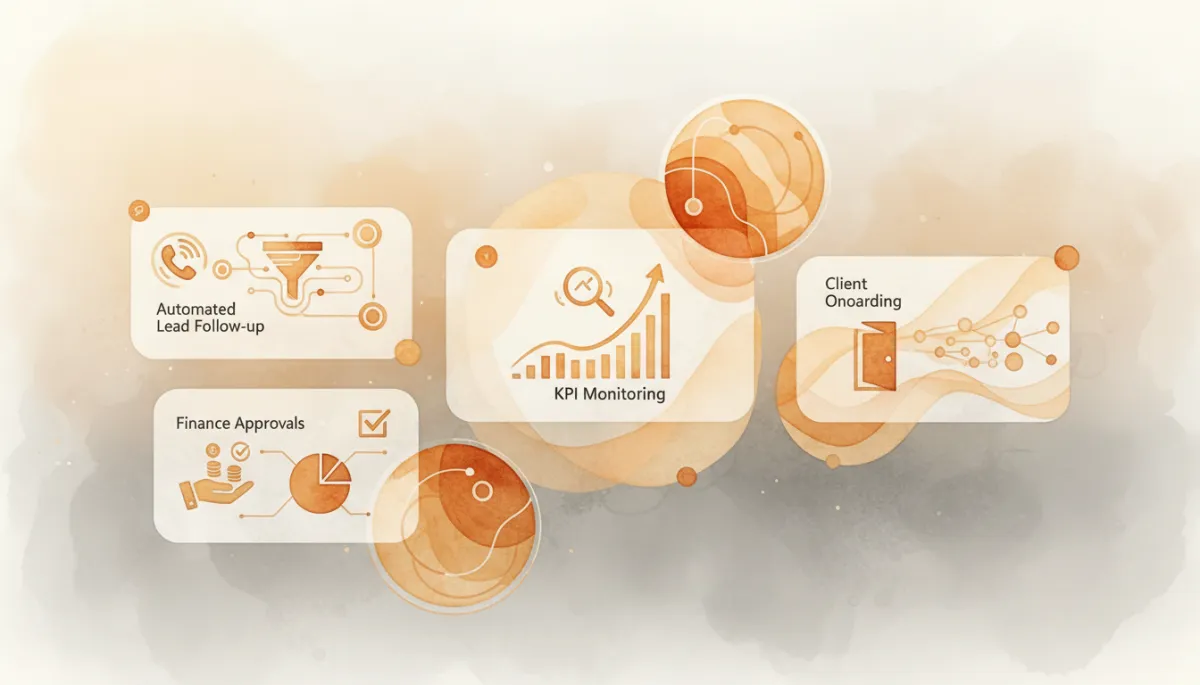
A single control layer lets leaders oversee dozens of autonomous AI workflows safely.
The Hidden Challenges: Why Many Agentic AI Pilots Stall or Backfire
Despite the hype, not every business or agency enjoys a smooth ride with Agentic AI. Many pilots stall after a few months, or get quietly shelved because they create more risk, confusion, or manual cleanup than value. From our work with teams exploring automation, the most common pitfalls include:
Tool-first thinking: Buying a shiny AI platform without a clear business problem or success metric, then struggling to justify the spend.
Fragmented infrastructure: Data, workflows, and access rights scattered across tools, making it hard for agents to operate safely and consistently.
Lack of governance: No clear rules for what agents can and cannot do, or how humans review, approve, and override their actions.
Change fatigue: Teams overwhelmed by yet another tool, especially if workflows are redesigned without their input.
💡 Pro Tip: Successful AI automation starts with one or two high-value workflows and clear guardrails—not a wholesale reinvention of your entire business in one quarter.
How Autocraft Studios Helps You Harness Agentic AI—Without Losing Control
Autocraft Studios specializes in helping businesses and agencies move from scattered experiments to reliable, governed Agentic AI systems that deliver measurable outcomes. Instead of pushing a single tool, we act as your strategic and implementation partner—designing, building, and refining agentic workflows tailored to your operations, clients, and risk appetite.
1. Strategy First: From Trend to Tangible Roadmap
We start with a structured discovery process that translates the abstract promise of Agentic AI into a clear, staged roadmap for your organization. Together, we:
Map your current processes across sales, delivery, operations, and finance, identifying “automation-ready” workflows and bottlenecks
Prioritize use cases by impact and feasibility—often starting with lead handling, onboarding, or reporting, where value is easiest to prove
Define success metrics (e.g., response times, conversion rates, time saved, error reduction) and governance thresholds
The result is a phased Agentic AI roadmap that aligns with your commercial goals and operational reality, rather than a generic “AI transformation” slide deck.
2. Designing Your Agentic Architecture and Unified AI Stack
A major 2026 trend is the shift toward unified AI infrastructure —consolidated stacks that bring together data ingestion, orchestration, model management, and governance. Over half of large organizations are expected to deploy such unified stacks by 2026, replacing fragmented one-off projects. Autocraft Studios helps you design an architecture that fits your scale and stack, typically including:
A secure data layer: where your key operational data (CRM, finance, tickets, projects) is accessible to agents with clear permissions and audit trails
An orchestration layer: connecting tools like Make, n8n, UiPath, or Zapier agents with large language models and your internal APIs
A governance layer: role-based access, approval flows, logging, and monitoring so you always know what your agents are doing and why
We are tool-agnostic. Depending on your needs, we might leverage no-code/low-code platforms like Make or Zapier agents for fast iteration, or integrate with enterprise platforms such as Oracle Fusion Agentic Applications, UiPath, or Microsoft Copilot enhancements for organizations already invested in those ecosystems.
3. Building and Deploying Autonomous Workflows That Deliver Real Outcomes
Once the architecture is in place, we design and implement concrete agentic workflows. For example, for a growing B2B agency, we might deploy:
Lead Ops Agent: Watches all inbound channels, enriches and scores leads, drafts personalized responses, and books meetings on the right rep’s calendar—only escalating edge cases to humans.
Onboarding Agent: Reads new contracts, sets up projects and folders, generates kickoff decks, and nudges clients and internal teams to complete prerequisites on time.
Reporting Agent: Pulls data from analytics, ad platforms, CRM, and billing tools, then assembles client-ready reports with narrative insights for account managers to refine and send.
Each workflow is launched in progressive autonomy modes —starting with “suggest-only” (humans approve every action), then moving to partial autonomy under defined rules, and finally to full autonomy where it’s safe and clearly beneficial. This staged approach builds trust and minimizes disruption for your teams and clients.
4. Governance, Trust, and Ongoing Optimization
As AI moves from experiments to core operations, governance becomes critical. Industry research shows a rise in formal roles like automation owners responsible for maintaining process maps, monitoring exceptions, and aligning automation with business goals. Autocraft Studios helps you implement:
Clear responsibility models: who owns each agent, who approves changes, and how escalations work when something goes wrong.
Monitoring dashboards that show agent activity, success rates, and anomalies in plain language for business leaders—not just technical logs.
Continuous optimization loops using process mining and feedback from your teams to refine prompts, rules, and workflows over time.
Where necessary, we also incorporate security solutions designed for agentic systems—such as runtime protections that detect suspicious agent behavior, prompt injection attempts, or unauthorized tool usage—so your automation layer is both powerful and safe.
What This Looks Like in Practice: Example Outcomes for Businesses & Agencies
While every engagement is different, businesses and agencies typically see a similar pattern of results when Agentic AI is thoughtfully implemented. Here are illustrative examples of what Autocraft Studios aims to deliver:
Faster sales cycles: Lead response times drop from days to minutes, with AI agents handling first-touch outreach and nurturing, leading to significant improvements in qualification rates and booked meetings.
Reduced operational drag: Routine tasks like data entry, reporting, and status updates are offloaded to agents, freeing teams for strategic work and creative problem-solving.
More consistent client experience: Onboarding, check-ins, and reporting happen on time, every time, regardless of individual capacity or bandwidth.
Better decisions from real-time visibility: Leaders see a live picture of pipeline health, delivery risk, and financial performance, with agents surfacing insights instead of buried dashboards.
How to Get Started with Autocraft Studios on Your Agentic AI Journey
If you are a business or agency leader, you do not need to become an AI architect overnight to benefit from this trend. You do, however, need a partner who understands both the technology and the real-world constraints of running a growing organization. Autocraft Studios typically guides clients through three practical steps:
Discovery & Opportunity Mapping: A focused workshop to understand your current operations, identify 3–5 high-value automation opportunities, and align on priorities and success metrics.
Pilot Design & Build: We select one or two flagship agentic workflows—often in lead handling, onboarding, or reporting—and design, implement, and test them with clear governance and human review loops.
Scale & Standardize: Once the pilots prove value, we help you extend agentic automation to adjacent workflows, formalize governance, and embed automation thinking into your operating model.
📌 Key Takeaway: You do not need a “big bang” AI transformation. A well-chosen first agent that demonstrably saves time or grows revenue is often enough to unlock internal momentum and buy-in.
Looking Ahead: Agentic AI as a Core Part of Your Operating System
By 2026, AI business automation is no longer a side project. With agentic systems, unified AI stacks, hyperautomation, and embedded generative AI in everyday tools, we are moving toward a world where autonomous agents are part of the operating system of every modern business and agency.
Those who treat Agentic AI as a passing trend will likely find themselves outpaced by competitors whose “digital workforce” of agents works around the clock—qualifying leads, orchestrating delivery, and surfacing opportunities long before a human would have time to notice. Those who embrace it thoughtfully, with clear strategy and strong governance, will gain a durable advantage in efficiency, responsiveness, and client experience.
Autocraft Studios exists to help you join the second group: to turn trending technology into practical, reliable automation that your teams trust and your clients feel. Whether you are just beginning to explore AI automation or ready to scale beyond isolated experiments, we can help you design, build, and govern agentic systems that fit the way your business really works.
If you are ready to explore what Agentic AI could do for your organization, consider this your invitation to start a conversation. The technology is ready. The cost barriers have fallen. The competitive gap is widening. Autocraft Studios can help you close it—on your terms, at your pace, with a clear line of sight from automation to business outcomes.

